
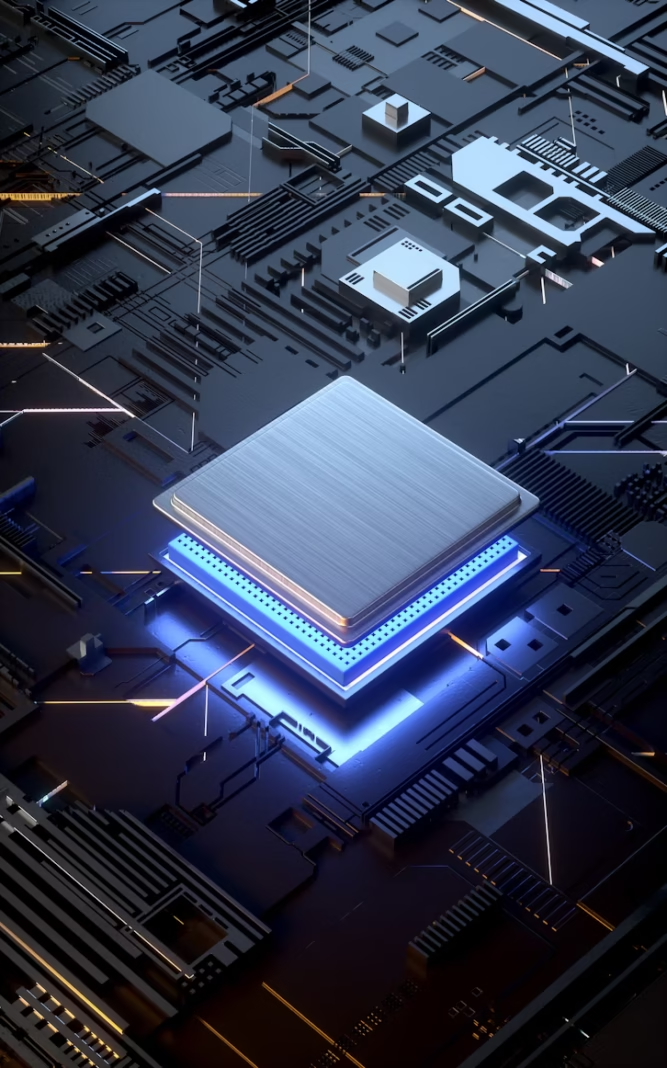
When transistors shrink smaller than strands of DNA, and learn to perform the same tricks – inside the personal computer revolution that re-invented the economy and transformed our world. Introduction: The Impossible Liminality Picture being able to pick up a chip the size of your fingernail and knowing that it has more transistors than there are stars in the Milky Way. We are at a critical juncture in the history of technology. As the world discusses the future of artificial intelligence and quantum computing, a quieter revolution is happening in Taiwan’s clean rooms. Down to 2nm, transistors are tiny – smaller than a strand of DNA – at a scale tiny enough to be about individual atoms, which becomes important to consider for architecture.
Chips made with these technology have 10%-15% higher computing speed at the same power level or operate with 20-30% reduced power consumption at the same speed and have a transistor density of roughly 15% over 3nm technology.
At the 2nm level, we’re at a point where quantum effects start to become major issues in chip design as well. Transistor gate lengths are now reaching the scale of only a few tens of atoms. A single speck of dust can spoil a wafer that holds billions of these tiny switches, which is why semiconductor fabs are among the cleanest environments humans have ever made. The way the things are made is incomprehensible in of itself. Legacy photolithography, which imprints patterns into silicon wafers using light, hits a fundamental wall when those features become smaller than light waves. computing.
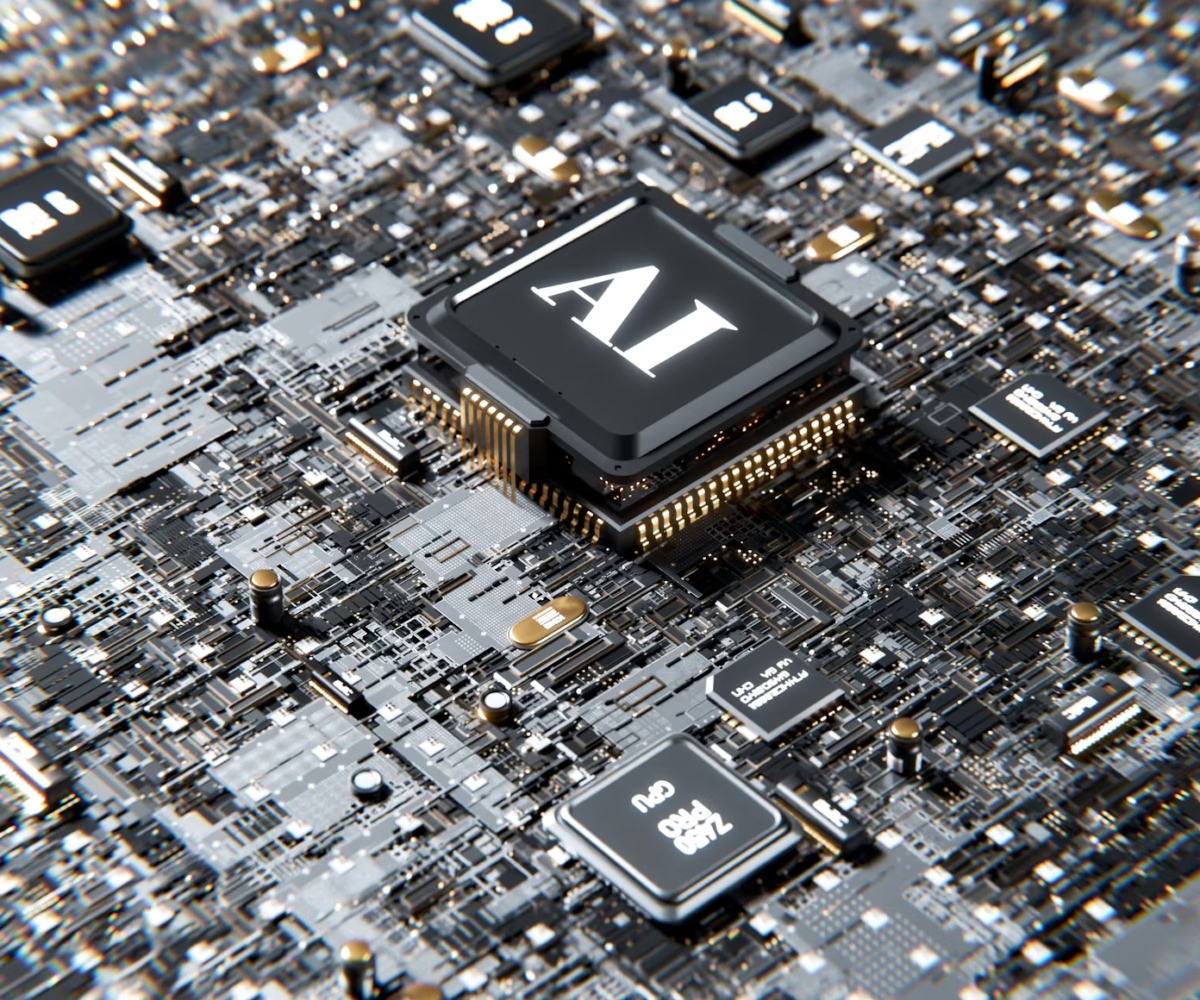
Nowhere perhaps is where we will see the influence of 2nm technology as immediately as in autonomous systems. Autonomous vehicles, delivering drones, and robotic helpers, for example, depend on huge levels of computation to handle sensor data and make real-time decisions while doing so safely.
Let’s be real—self-driving cars these days? Basically, you’re riding around in a mobile server farm. It’s like they stuffed a NASA control room under the hood, with processors stacked on processors, all of ’em gobbling up power and cranking out heat like there’s no tomorrow. And that’s not just a little quirk—these energy-hungry brains mean even the fanciest electric robo-car can’t go as far as you’d hope. Plus, all that heat? Total headache for folks trying to keep the thing from turning into a rolling oven.
Designing these cars is basically a balancing act between not frying the whole system and squeezing out a few more miles per charge. Not exactly the Jetsons’ future we were promised, huh? 2nm-enabled autonomous edge devices will achieve unmatched efficiency and performance. Vehicles would be able to process sensor data from cameras, lidar, radar and other inputs with human-level refinement while consuming less energy than today’s entertainment hot rods. It allows small, light, more efficient, longer range and lower cost, energy independent Quantum vehicles. But the uses go far beyond transportation.
Picture this: robots on the assembly line, not just doing the heavy lifting but actually making calls like a human would. No waiting for someone to tell them what’s next—they just get it done. And drones? Man, those things could stay in the air forever, scoping out disaster zones, coordinating rescues, maybe even pulling off moves we haven’t dreamed up yet. But the real wild stuff is out in space. Rovers are gonna need to get a lot smarter, thinking for themselves instead of twiddling their digital thumbs waiting for Earth to phone in. When you’re cruising around on Mars or whatever, you better not need a supervisor.. Makes sense, right? Those time delays are brutal.
Switching gears, let’s talk chips. TSMC is on a roll, honestly. They’ve got this roadmap—everyone’s buzzing about it. 2025? That’s when the 2nm chips hit the stage. Then, just two years after, bam, 1.4nm goes into production. Wild how fast this stuff’s moving. Makes you wonder what’s next—half the size, double the hype? Who knows. But the road map to get past traditional silicon scaling is to look at even more radical technologies.
Basically, you’re just stacking layers of transistors like a high-tech lasagna. Instead of shrinking the stuff on a chip, you just go vertical—cram in way more punch without the whole nanometer headache. And then there’s this fancy packaging business—imagine mixing and matching all kinds of processors in one setup: classic CPUs, photonic chips, brain-inspired neuromorphic stuff, even quantum bits if you’re feeling wild. Mash ‘em together, let ‘em each do what they’re best at, and boom—your computer suddenly turns into a Swiss Army knife for crunching data. Other materials, beyond silicon, might allow other ways to perform information processing. When it comes to specific applications, there’s also gallium arsenide.
The popularisation of AI power will unleash innovations we can hardly conceive of now. Scientific research might take off at a breakneck pace as AI systems help generate hypotheses, design experiments and analyze results. This presents human creativity and challenges for economic systems structured around conventional employment. these chips are basically the keys to unlocking some wild sci-fi level tech. I’m talking about stuff that’d make your iPhone look like a potato. Once they crack 2nm, we’re not just getting faster gadgets, we’re talking a whole new breed of machines—think AI that actually gets you, photonic computing that zips around at the speed of light, and brain-inspired chips that make today’s devices seem like ancient relics.
Medical instruments capable of identifying and treating diseases at the cellular level, even before a patient shows symptoms. Self-driving cars that safely maneuver through difficult conditions at superhuman perception and reaction speeds. Fabs that make one-of-a-kind objects with the same efficiency as those of a Roleflex. Instruments that can see deeper in the universe and back through time with greater ability than any before.
Leave a Reply